

Agency, Consultancy, In-House, or Embedded: An Honest Comparison

Ask a marketing leader how to get the work done, and you will usually get a tribal answer. Agency people defend agencies. In-house leaders swear by owning it. Consultants sell frameworks. And the growing crowd of fractional and embedded operators, myself included, will tell you the old models are tired.
I want to do something less convenient here and compare them honestly. Over the past 25 years, I have worked in all four. I have hired agencies. I have built in-house teams and served as the interim leader for them. I sat in a global consultancy early in my career, and now I work as an embedded operator within a collective. Each model is a set of trade-offs. The trick is matching the model to the moment, not marrying one for life.
Here are the four, compared across the things that actually matter: cost, speed, expertise, and ownership.
The four ways to get marketing done
An agency is an external team you engage on a retainer or by project. Its strength is the breadth of craft and the capacity to scale production across many workstreams and markets.
A consultancy sells senior strategic thinking: diagnosis, frameworks, and recommendations. Its strength is intellectual horsepower on hard, ambiguous questions. Implementation is usually left to you.
An in-house team is your own employees. Its strength is ownership and context. Nobody understands the business, the customer, and the politics better than the people who live it every day.
An embedded operator, whether a solo fractional leader or someone working through a collective, is a senior expert who joins your team and does the work, for as long as you need them and no longer. The strength is senior hands directly on the problem, close to the outcome, without a permanent hire or a heavy structure.
Cost: What are you really paying for?
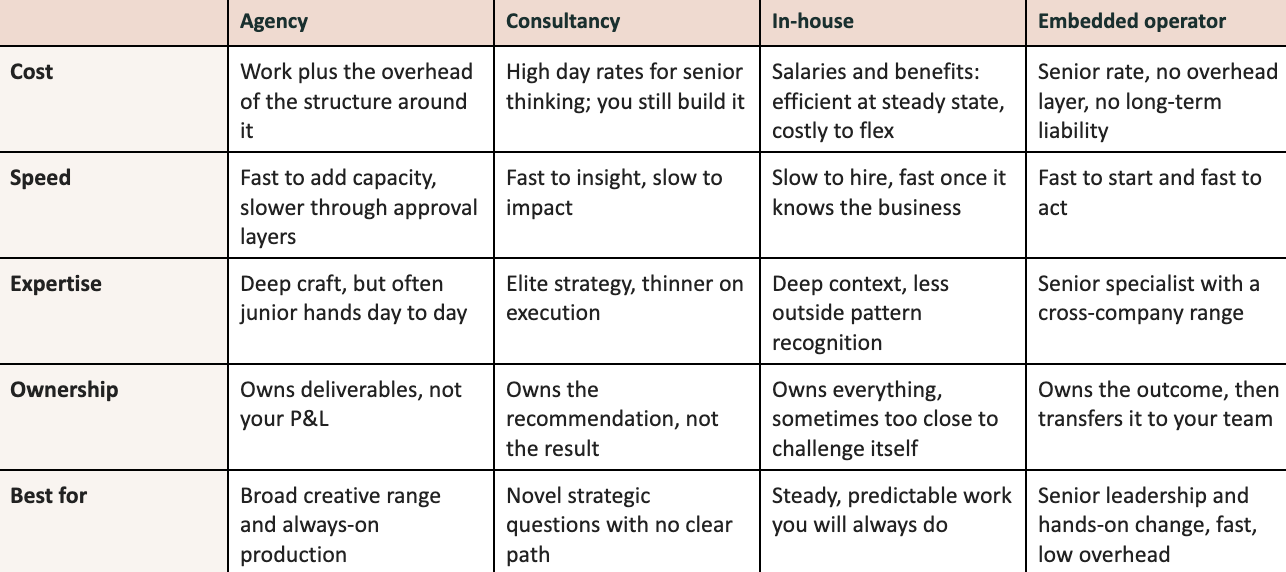
An agency bundles the work with the overhead of its structure: account management, coordination, new-business costs, and margin. A consultancy charges premium day rates for senior thinking, but you still have to build whatever they recommend. In-house looks cheap at steady state, until you count benefits, ramp time, and the real cost of a misfire or of carrying capacity you do not always need. An embedded operator costs a senior rate, but with almost no overhead layer and no long-term liability. You pay for the seat you actually need.
Speed: time to insight vs time to impact
Agencies spin up capacity quickly, then slow down through approval layers and account management. Consultancies are fast to insight and slow to impact, because the doing is on you. In-house is slow to hire and fast once the team knows the business. Embedded operators tend to be fast on both ends: a senior person starts quickly and acts directly, because there is no one to hand the work down to.
Expertise: seniority where it counts
Agencies employ genuinely deep craft specialists, but the hands-on people on your account day to day are often more junior than the talent you met in the pitch. Consultancies bring elite strategic minds and thinner execution muscle. In-house teams have unmatched business context but can lack an outside perspective and can go a little stale without fresh input. An embedded operator brings a senior specialist with cross-company pattern recognition, though it is one person, unless a collective bench sits behind them.
Ownership: who is on the hook for the outcome?
This is the dimension that people are underweight, and it matters most. An agency owns its deliverables, not your P&L. A consultancy owns the recommendation, not the result. An in-house team owns everything, which is the point, though sometimes it is too close to the problem to challenge itself. A good embedded operator owns the outcome while they are there, and then does the thing the others rarely do: transfers ownership to your team on the way out, so the result outlasts the engagement.
The comparison at a glance
So how should you choose?
Start with the problem, not the provider. If the work is steady and predictable and you will do it forever, build it in-house. If you need an enormous creative range or always-on production across many markets, an agency earns its keep. If you are facing a genuinely novel strategic question with no clear path, a strong consultancy is worth the fee. And if you need senior leadership and hands-on execution to drive change quickly, without the overhead or the permanent hire, an embedded operator is hard to beat.
The honest part
Each model wins somewhere. My bias is toward embedded operators, because most of what businesses actually need is a senior person who will do the work and own the outcome, close to the number, without a structure to feed. But if you need forty creatives producing across a dozen markets by next quarter, I will point you to an agency and mean it.
The mistake is rarely picking the wrong model. It is defaulting to one out of habit or loyalty when the situation calls for another. Be honest about what has to change, how fast, and who will own it once the outside help is gone. The right model usually emerges from that answer.
If you are weighing this for your own business, I am always happy to talk it through, with no pitch attached. Book some time here.
The piece was originally published on Ray Smale's LinkedIn account and is shared here with his permission. Ray is a fractional and interim CMO at Chameleon Collective, known for embedding directly into leadership teams to get stalled growth moving again, building brand, funnel, and team so the results outlast the engagement.
Newsletter
Get the Collective POV in your inbox
Perspectives on transformation, leadership, and growth from 280+ senior operators. No fluff, no spam.