

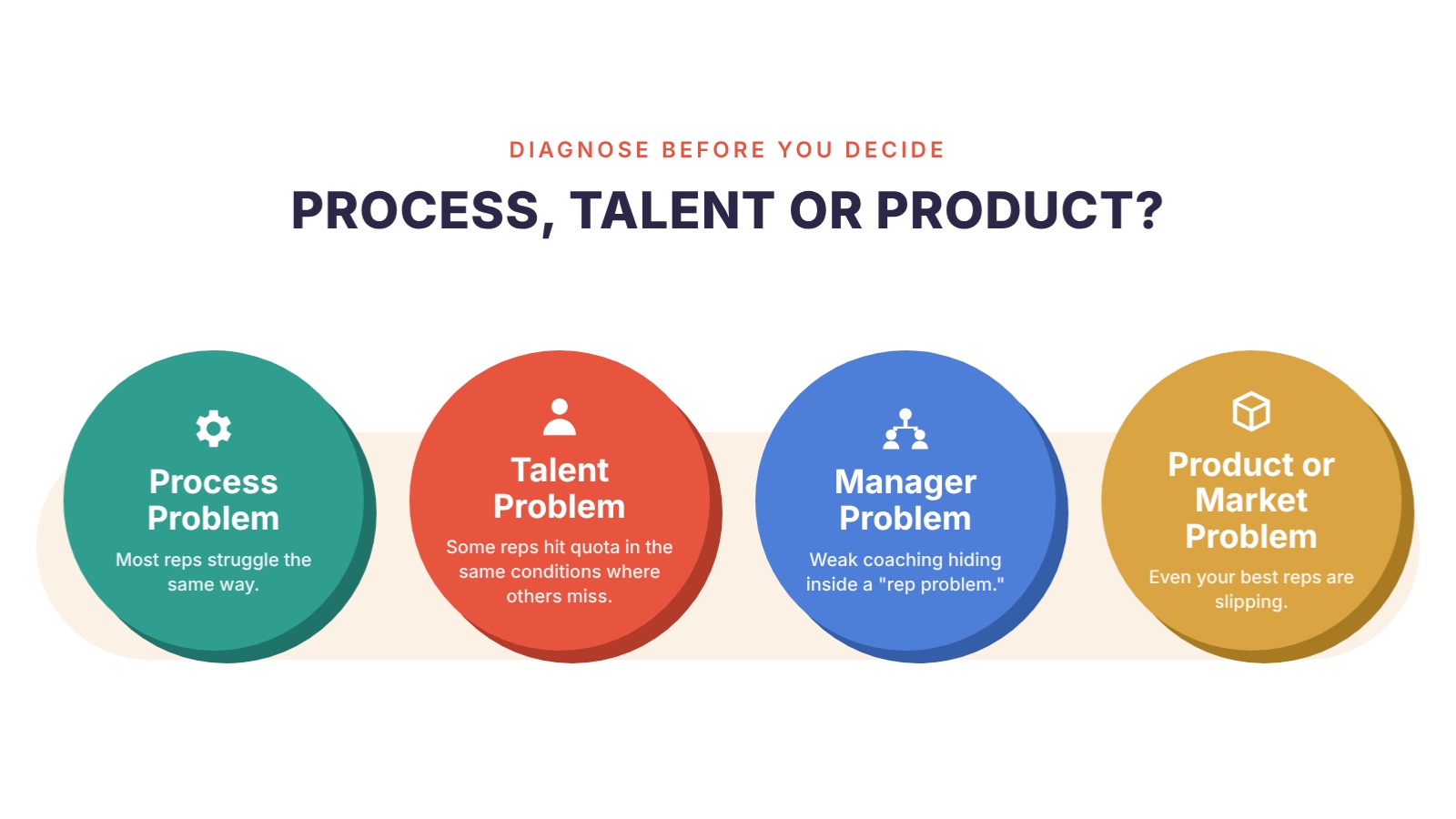
How an interim sales leader diagnoses process versus talent versus product problems before making personnel calls.
When a sales team misses its number two or three quarters in a row, the pressure to replace people is enormous. The board wants action. The CEO wants a new name on the org chart. And swapping out reps or a sales leader looks decisive and seems like the right thing to do.
It is also often the most expensive way to learn nothing. If the real problem is a broken process or a product that no longer fits the market, new hires walk into the same wall. Six months later, after recruiting, ramp time, and lost pipeline, the company is back where it started with fewer people who deeply know the customers.
When I step in as an interim sales leader, my first job is not to decide who stays. It is to figure out what is actually broken and ensure what works can be replicated. Underperformance almost always comes from one of three places: process, talent, or product and market fit. While financial underperformance can look the same on a board slide, they need very different approaches to solve.
Here is the 90-day approach I use to inspect these three areas before making a single org or personnel decision.
In the first two weeks, pull a trailing four to six quarters from your reporting dashboard and your customer relationship management (CRM) system. Don't try to fix data quality first. Messy data is itself a finding.
Stage-to-stage conversion, by rep and by team. Build a simple grid of reps against stages. If one column is red for everyone, that is a process or product signal. If the red is scattered, it is a talent signal.
Quota attainment distribution. Plot every rep's attainment, not just the team average. A tight cluster below target points to the system. A wide spread with a few people at or above plan points to the people, or potentially to how territories were assigned.
Win/loss by reason, segment, and competitor. Look for concentration. Losing most competitive deals to one rival, or to one blocker, or most deals in one segment, is rarely a rep problem.
Sales cycle length and deal size over time. Cycles stretching while deal sizes shrink often means you are selling to the wrong buyer or the wrong customer profile.
Forecast accuracy by rep. Compare what each rep committed at the start of the quarter with what closed. This shows who understands their deals and whether stage definitions are being utilized appropriately.
Pipeline sources and coverage. Check how much pipeline comes from marketing, sales development, partners, and reps themselves. A pipeline gap can look like a closing problem when it is really a demand problem.
Ramp time for the last several hires. If new reps take far longer than planned to produce, look at onboarding, territory quality, and enablement before judging the productivity of new hires.
Territory and account assignment. Check whether the best performers simply have the best accounts. Normalize for territory before comparing person to person.
By day 14, you should be able to write down a working hypothesis for each of the three buckets.
The data tells you where to look. The next step is to uncover the why. In weeks two through four, I spend most of my time here.
Listen to 15 to 20 recorded calls across at least five reps. Mix top, middle, and bottom performers. Score each call on the same few items: did the rep validate the business problem, identify the decision maker, agree on a next step with a date, and quantify the value? If everyone skips the same step, it was never taught or expected. If only some skip it, it is a coaching gap.
Run deal reviews on 10 open and 10 recently lost opportunities. Ask each rep the same three questions: Why will this customer buy? Why now? Why us? Vague answers across the board point to a qualification process problem. Strong answers on deals that still lose point to product or pricing.
Interview five to eight customers who said no, and three to five who said yes. Do it yourself, not through the rep. Ask what almost stopped the closed won from buying and what decided it for the closed lost deals. Lost customers are the most honest source you will find on product fit.
Hold one-on-ones with every rep and frontline manager. Ask: What gets in your way every week? What would you change first? Who on this team is great, and why? Patterns emerge fast, and people often name the process problems leadership has stopped seeing.
Walk the handoffs. Follow one lead from marketing to sales development to account executive to customer success. Count the delays and the dropped balls. Many "talent" complaints are really broken handoffs.
Sit with product and customer success leaders. Ask what customers request most, what churns, and what sales promises that the product cannot deliver.
At the end of day 30, I share a one-page diagnosis with the CEO: what I believe is process, what is talent, what is product, and the evidence for each. No personnel decisions yet, unless there is a clear integrity or conduct issue.
Process fixes are the cheapest, fastest, and least disruptive changes you can make. They also level the playing field, so the talent picture becomes clear. You cannot fairly judge a rep running a broken play.
The fixes I reach for most often:
Define every pipeline stage with exit criteria. Each stage gets two or three things that must be true before a deal moves forward, such as "economic buyer identified" or "mutual close plan agreed." Put them in the CRM as required fields.
Pick one qualification method and enforce it. It matters less which one you choose than that everyone uses the same language in every deal review.
Set a weekly operating rhythm. One pipeline review per team, one forecast call, one coaching session per rep. Same day, same format, same questions. Cancel the meetings that duplicate these.
Write down the handoff rules. Agree with marketing on what counts as a qualified lead, how fast sales must follow up, and when customer success joins the deal. Measure it weekly.
Clean up territories and pipeline. Disposition deals that have not moved in 90 days. Validate what’s real pipeline and why. Rebalance accounts where one rep has the best ones, and another has leftovers.
Give reps two or three core tools, not ten. A short call guide, a discovery question set, and one proof point per main use case usually beat a 60-slide enablement deck. Test and mature skills, put the practice work into motion, before adding to the tech stack.
Fix the compensation plan only if it is clearly driving the wrong behavior. Mid-year comp changes are disruptive. Do it when, for example, reps are paid on bookings that churn in a quarter.
Then measure for four to six weeks. Watch whether stage conversion moves and whether the gap between reps widens or narrows. Reps who improve quickly once the system works were never your problem. Reps who stay flat with the same support are now a fair conversation.
By now you have six to eight weeks of each person working inside a clearer system. Personnel decisions made at this point are fairer, easier to explain, and far less likely to be wrong.
Look hard at the managers. In my experience, a weak frontline manager is the most common talent problem hiding inside a "rep problem." Ask: Do their reps know what good looks like? Do they coach on real calls every week, or only review the forecast? Is their team's performance spread wider than other teams'? Replacing one manager can lift an entire team without changing a single rep.
Separate the decision from the timing. Once you have decided, act within two to three weeks. Long, visible uncertainty costs you your best people.
Explain the why to the team. When people can see the decisions were based on the same evidence for everyone, the ones who stay trust the process more, not less.
This is the hardest finding to deliver, because from the outside it sounds like sales making excuses. The way through is to bring evidence, not opinions, and to bring options, not complaints.
Show the pattern, not the anecdote. Instead of "reps say we lose on features," show that a large share of competitive losses went to one competitor, with the same capability cited in the lost-customer interviews.
Use customer words. Five direct quotes from buyers who said "no" carry more weight with a CEO and product leader than any sales leader's view.
Separate fit from pricing from packaging. Sometimes the product is fine for a narrower customer profile, or the pricing model doesn't match how buyers budget. Those are faster fixes than a roadmap change.
Propose a focused bet. For example: concentrate the team for two quarters on the segment where win rates are healthy, while product closes the gap in the other.
Agree on a shared metric. Give sales and product one joint measure, such as win rate in the target segment, so the conversation stays about the customer and not about blame.
If the core issue is product or market fit, replacing the sales team will only delay the real decision. Say so plainly, early, and with the data.
Before you make a personnel change in a struggling sales organization, make sure you can answer yes to each of these:
I have looked at performance by rep, not only the team average.
I have compared reps after adjusting for territory and account quality.
I have listened to real calls and reviewed real deals for this person.
I have talked to customers who bought and customers who didn't.
Pipeline stages, qualification, and handoffs are clearly defined and practiced by every seller.
This person has worked inside the improved process for at least four to six weeks.
I have checked whether the issue is at the rep level or at the manager level.
I have ruled out product, pricing, or market fit as a critical cause factor.
I have considered whether a different role would fit this person better.
A proven performer would succeed in this seat as it exists today.
An interim leader comes in with no loyalty to past hiring decisions, no stake in the old process and a fixed window to deliver. That makes it easier to look at the evidence objectively and say what others in the room might suspect but didn't action.
Over more than 20 years leading go-to-market teams at Google Cloud, Amazon Web Services (AWS), Microsoft, and LinkedIn, I have seen teams turned around without large-scale replacement, and I have seen the right hard call change a team's trajectory. The difference was never speed. It was surgical diagnosis. Fix the system first. Then you will understand with greater confidence the talent opportunities that remain.

Maria Groeschel
Newsletter
Perspectives on transformation, leadership, and growth from 280+ senior operators. No fluff, no spam.