

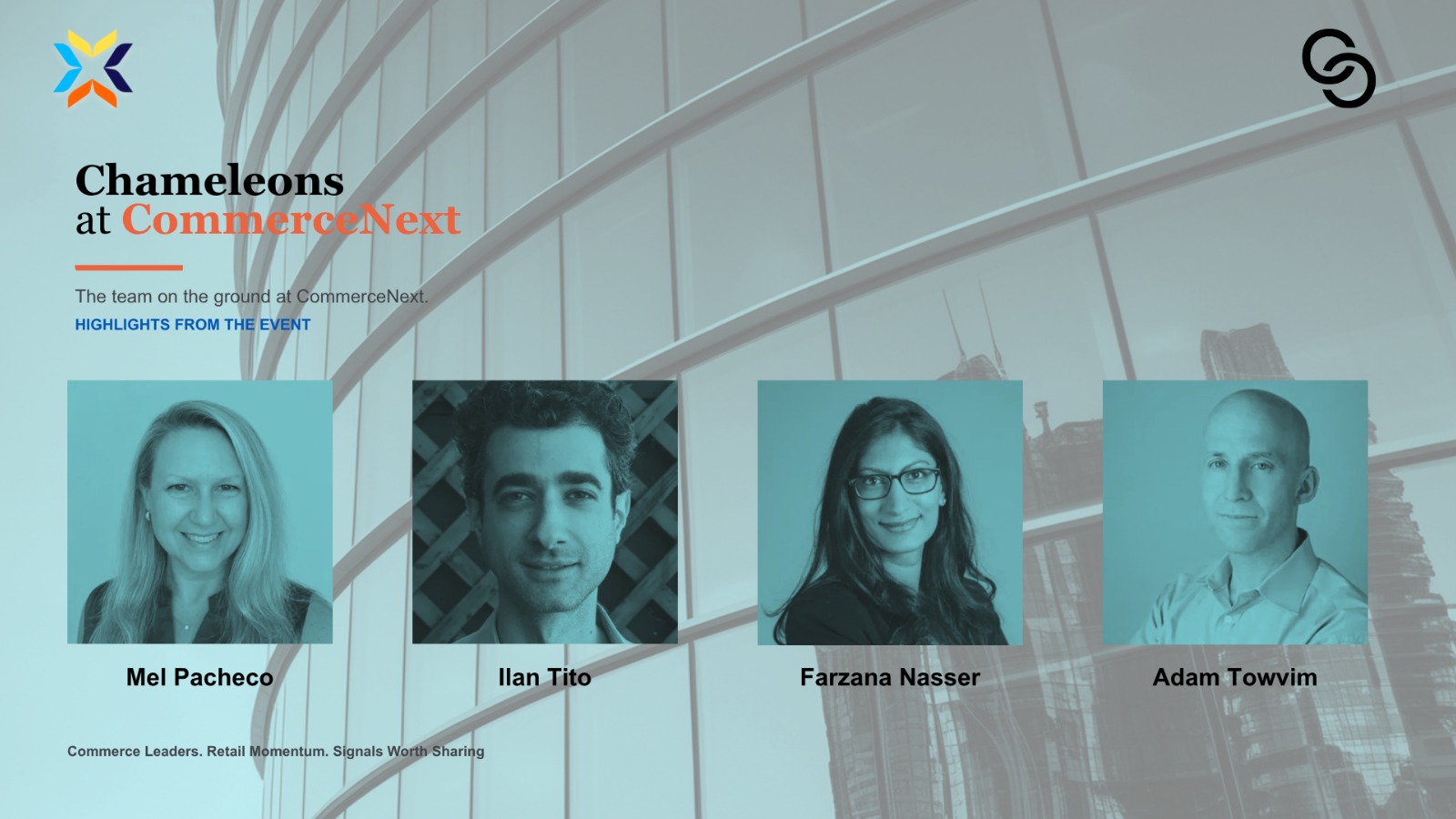
Every year, CommerceNext pulls together the retailers, brands, technology partners, and operators who are actually building the future of ecommerce, and every year, Chameleon Collective shows up in force. This time was no exception. Farzana Nasser sat on the advisory board, hosted the Omnichannel Track, and led the Marketing Suite Tour. Adam Towvim, Mel Pacheco, and Ilan Tito were in the rooms and hallways collecting insights of their own.
We asked each of them what stuck. Four different vantage points, one very consistent message: AI is no longer a topic for the main stage. It is showing up in every function, from the way brands market to the way they hire to the way customers find them in the first place. And in every case, the brands pulling ahead are the ones pairing that technology with real human judgement, not replacing one with the other.
Farzana's biggest takeaway came from an unexpected source: the final keynote of the conference, typically the moment when a room starts checking flight times. Not this year. When retail veteran Millard "Mickey" Drexler took the stage, the room went quiet.
One line from Drexler stayed with her: retail has largely lost its creative edge in favour of discounting. It is a trap Farzana sees often in her work with high growth brands. Discounts can move product in the short term, but they rarely build anything that lasts. The brands that consistently outperform do not win on price. They win because they build products people love, tell stories worth remembering, and create experiences customers cannot get anywhere else.
Her broader read on the week echoed that idea. Across the sessions she hosted and the conversations she had on the show floor, a few themes kept resurfacing: AI is moving from experimentation into real execution, profitable growth is still the priority over growth at any cost, customer experience remains one of the biggest competitive advantages a brand can build, and the companies making the most progress are the ones connecting technology to strong operational execution, not just adopting tools for their own sake.
Adam's summary of the week reads like a checklist for anyone worried they are falling behind, and his central point is reassuring: adoption alone will not save you. AI is genuinely reshaping ecommerce, but human judgement is still what separates a flashy experiment from a durable business advantage. Every brand needs to be AI-ready, but readiness is not the finish line.
The same logic applies to omnichannel. Winning is no longer about simply having a presence across channels. It comes down to disciplined, coordinated execution at every customer touchpoint, what Adam calls ecommerce orchestration, and he sees it as the difference between brands that talk about omnichannel and brands that actually deliver it.
He also pointed to a shift in how growth gets built. First-party data, sharper measurement, and faster decision-making are becoming essential for turning customer signals into revenue, a discipline he calls growth engineering. Loyalty is evolving too, moving well past points programmes toward retention, lifetime value, and the post-purchase experience, all backed by data showing that shift is real. And discovery itself is changing shape, with live shopping, creator commerce, and AI-powered chat experiences altering how buyers find, evaluate, and purchase. His conclusion: the best ecommerce companies, B2C or B2B, will be those that combine technical sophistication with a genuinely deep understanding of their customers.
Mel's lens was talent, and her takeaways make a strong case that some of the biggest ecommerce challenges are really people challenges in disguise.
Companies are still hiring, she noted, but with far more discipline than in years past. The question has shifted from simply filling a role to asking whether it is the right role, tied to the right business problem, with the right capabilities for where the company is actually headed. Often, she pointed out, the real issue is not a talent gap at all. It is structure, process, unclear ownership, or work that needs to be redesigned.
AI is reshaping hiring from both directions. Candidates use it to polish resumes and prep for interviews, while companies use it to screen and evaluate, which makes a genuine signal harder to find. In a market where polish is cheap, judgement, curiosity, adaptability, and the ability to explain the thinking behind the work matter more than ever. AI fluency is quickly becoming part of that conversation too, but Mel was clear that it cannot just be a bullet point on a job description. Leaders need to define what AI capability actually looks like by function and level, then connect that definition to hiring, training, and performance expectations.
Her closing point may be the most useful for any leader building a team right now: retention is not a perks problem, it is a design problem. Top performers stay when they have clear ownership, strong managers, modern tools, honest communication, real growth paths, and a genuine reason to believe the company is worth growing with.
Ilan's takeaways zoomed out to the customer journey itself, and his read is that the ground is shifting faster than most brands realise. The journey is being re-architected around AI search, with real implications for acquisition, merchandising, customer experience, and retention. His advice is direct: brands need to rethink their funnel around agentic demand, where AI systems are doing the searching and evaluating on a customer's behalf.
He also highlighted a comment from the Tractor Supply CMO that resonated with him: as AI increasingly commoditizes brand discovery and the customer journey, knowing exactly who your customer is, and never stopping the work of serving them better, becomes more important, not less. Additionally, while there is growing pressure across the industry to put AI to work, Ilan noted that understanding how to actually use it well still varies widely. Most companies are still figuring out how to move past tactical efficiency gains and use AI to genuinely scale their business.
Put these four perspectives side by side and a clear picture forms. AI is not a future consideration anymore, it is already reshaping marketing, hiring, and the customer journey all at once. But in every conversation, the winning move was never the technology alone. It was the human judgement applied on top of it: the creative instinct to build something worth talking about, the discipline to execute rather than just experiment, the clarity to define what good actually looks like, and the willingness to keep asking who your customer really is.
What insights would you add to this list? And what actions are you implementing to impact 2H 2026 and beyond?
Newsletter
Perspectives on transformation, leadership, and growth from 280+ senior operators. No fluff, no spam.